
Stations
The first interface
into the network.
A rewatr Station is not a bin with a screen. It is a payment terminal for environmental action — industrial where it must be, precise everywhere it is touched.
Industrial design
Hard outside. Considered at the point of contact.
Powder-coated steel body, seamless intake aperture, recessed lighting that signals state from across a plaza. Everything a user touches sits within a single illuminated band; everything a technician touches is behind one keyed panel.
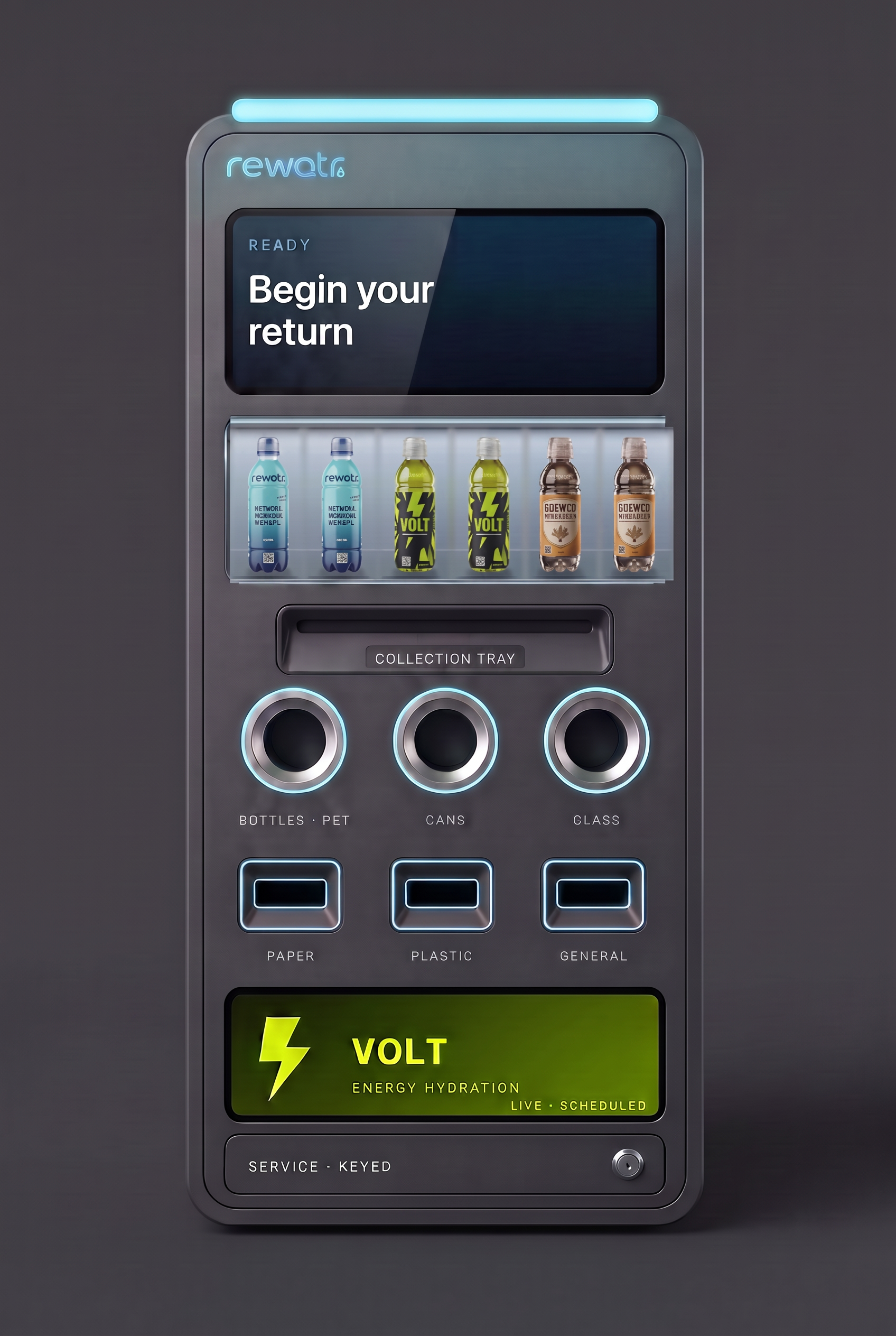
rewatr Station
One format · every site
- Sponsored water
- Chilled shelf of rewatr, VOLT and BREWCO editions, dispensed below the screen
- Circular intakes
- Plastic and rewatr bottles in one aperture, then cans, then glass
- Square intakes
- Paper, plastic and general waste, segregated at the point of drop
- Sponsor display
- Digital panel, scheduled centrally — no printed film to swap
- Service
- One keyed door. Six transparent boxes, each lifted out in seconds
- Segregation
- Streams stay separate from aperture to collection box
Anatomy
One station. One format. Every site.
Swipe →
Station UX
Six seconds that have to feel like a win.
The station screen is the product for most people.
Portrait, high contrast, readable standing at arm's length. One number dominates: what this session is worth. Every accepted item lands on screen with its own line, so the count itself becomes the reward.
01
Approach
The unit is awake and showing what the neighbourhood earned today.
02
Identify
One QR scan. No app install required for a first return.
03
Deposit
Material is recognised, weighed and accepted or explained.
04
Tally
Value accrues on screen with every item — the count is the reward.
05
Confirm
A deliberate confirmation beat, then the balance is settled.
06
Continue
Standing, streak and next milestone shown before the user walks away.
Fleet operations
Every unit reports for itself.
Health, fill level, throughput, uptime and firmware channel stream into the operator console. Collection is dispatched against real fill data rather than a fixed weekly route, which is where the operating cost of a return network is actually decided.